
Why Choose EduExpert
We are deeply familiar with the Erasmus+ programme, and we support schools throughout the entire process—from preparation and documentation to on-site assistance and post-course follow-up. Our goal is to make participation smooth, enjoyable and professionally rewarding for both teachers and coordinators.
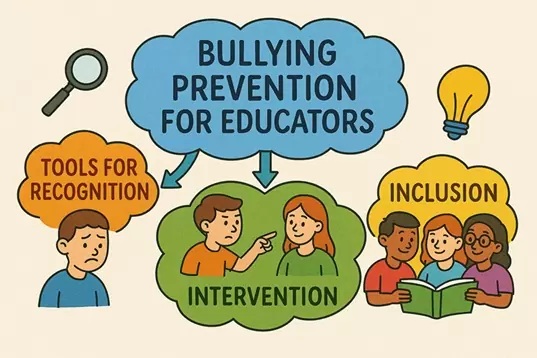
Bullying Prevention for Educators – Tools for Recognition, Intervention and Inclusion
- TBA
- 35 lessons, 7 days
- English, B1
- 11 July 2027
Description:
Bullying is not just a discipline issue—it’s a barrier to learning, well-being, and healthy development. This practical training supports teachers, school staff, and education professionals in understanding the dynamics of school bullying, learning to recognise warning signs, and implementing effective prevention and intervention strategies.
The course focuses on building safe classroom environments, promoting empathy and cooperation, and empowering students to be active participants in creating a culture of respect.
Key Topics:
- Types and patterns of bullying (verbal, physical, relational, online)
- Early identification and signs of bullying behavior
- The role of peer dynamics and group behavior
- Creating safe classroom rules and building trust
- Intervention techniques for teachers and school staff
- Empowering bystanders and supporting victims
- Cooperation with families and school communities
- Restorative approaches and long-term prevention
Aims and objectives:
Interactive methods include group discussions, role-play, video analysis, real-case scenarios, and collaborative planning. Participants will develop their own anti-bullying action plans tailored to their school context.
Learning outcomes:
Participants will:
- Gain confidence in identifying and responding to bullying cases
- Learn practical tools to build positive class climate
- Understand how to foster empathy and resilience among students
- Develop their school’s tailored anti-bullying strategy
Target groups:
-
Primary and secondary school teachers, school psychologists, classroom assistants, and school leaders.
Minimum level of language: B1 in English
Duration of training: 35 lessons, 7 days
Date:
- 11-17 July 2027- Planned
The final confirmation of the course is subject to reaching the minimum number of participants.
Location: Rovinj, Croatia
Price: EUR 560 + EUR 50 registration fee
This price includes the course, certificate, Erasmus+ documentation (if needed), welcome lunch or dinner and a cultural activity
Price is NET. VAT: 0% for organisations with a valid EU VAT number; in all other cases VAT may apply – please contact us for details.
Applicable funds: As part of the Erasmus+ Key Action 1 (KA1), all costs for mobility /travel expenses, course fees, accommodation, subsistence fee/ are covered by the fund.
Please click here to register if you wish to participate in this course.
Short Description
Class Times
| Sunday | Monday | Tuesday | Wednesday | Thursday | Friday | Saturday |
|---|---|---|---|---|---|---|
|
Day 1: Arrival, introduction of the course and the location, introduction of the participants
Registration during the day
14.30 – 15.00: Familiarisation with the site, health and safety briefing
15.00 – 17.30: Introduction of the course and trainer, introduction of the participants – 5 minutes for each participant to introduce themselves and their institution and the objectives they wish to achieve by completing the course
18.00 – 19.30: Informal get-together with the course participants over dinner.
|
Day 2: Understanding Bullying in the School Context
What is bullying? How does it differ from aggression, violence, and conflict?
Key characteristics and types of school bullying
The roles involved in bullying (victim, bully, bystanders, supporters)
Understanding the „circle of bullying”
Group discussions: reflection on personal experiences and new insights
|
Day 3: The Power of Bystanders and Peer Influence
The role of bystanders: from silence to support
Norms, conformity and the bystander effect in school settings
Intervention strategies for teachers: empowering students to act
Promoting a culture of speaking up and standing by victims
Pair work and sharing: how to strengthen bystander intervention
|
Day 4: School-Family Cooperation
School climate and institutional factors in bullying prevention
Risk and protective mechanisms within the school environment
School-wide strategies and policy-level prevention
Creating shared values and rules to prevent bullying
Group dialogue: What does a truly safe school look like?
|
Day 5: Whole-School Approach to Prevention
Activities: Developing effective time and priority management strategies.
Tasks: Using Covey’s time-management matrix with own tasks, simulation of a school leader’s daily schedule, creation of a personal weekly plan.
|
Day 6: Individual-Level Prevention & Wrap-Up
Translating theory into classroom action
Practical methods for daily use: empathy, resilience, classroom norms
Personal and professional responsibility in bullying prevention
Developing individual action plans
Final group reflection and feedback on the week’s learning
|
Day 7: End of the course – cultural programme
8.30 – 10.00: What did I learn this week? Preparing for dissemination – 5 minute presentation from each participant
10.00-10.15- Break
10.15-11.00: Evaluation and feedback of the course
Certificates, attendance certificates
Certificate issue – photography
11.30-16.00: Cultural programme – boat trip
|